Friday, February 25, 2011

Pear Tart in a perfect day

How do you define a perfect day? Barbecue with best friends, great food, perfect Los Angeles sunny Sunday... While my friend Yanush was barbecuing  trout with rosemary, Margo cooked a lot of veggies: okra, sweet potatoes, parsnips, fennel, spinach, asparagus, and delicious orange from the tree. When she served tea she brought to the table a Pear Tart she just made that Sunday morning.
Pear Tart is a delicious cake and a classic recipe. Since I uploaded this picture to Facebook I received many requests to post the recipe for the Pear Tart. Perfect time to publish the recipe, now that pears are in season and they can be found ripe and sweet at any local farmers' market and grocery store.


Pear Tart (Torta di Pere)

for the shell

1-1/2 cup flour
1/4 teaspoon salt
1/3 cup sugar
3 large egg yolks
1/2 teaspoon vanilla extract
1/2 cup cold unsalted butter, diced
for the tart
6 tablespoons unsalted butter
1-1/2 large eggs
1/2 cup plus 1 tablespoon sugar
3 tablespoons all-purpose flour
4 ripe pears (Anjou or Bartlett)
2 tablespoons lemon juice
for the glaze
1/2 cup apricot jam
1 tablespoon water
1/4 cup sugar

Preparing the dough


Sift the flour on a work surface and make a hole in the center. Place in the hole salt, sugar, egg yolks, vanilla and butter. Mix the butter with the yolks and draw the flour gradually into the mix.

Work quickly with your hands, to form dough—avoid warming the dough too much. Sprinkle lightly the work surface with some flour to prevent the dough from sticking to the table. When the dough is smooth, elastic, and consistent, form it into a ball cover with plastic wrap, and keep in the refrigerator for about 30 minutes to 1 hour.

Preparing the custard


Melt the butter and let it cool to room temperature. Place the eggs in a mixing bowl. Whisk in the sugar. Whisk in the flour. Whisk in the melted butter. Set aside.

Assembling the tart
Preheat oven to 375 F (180 C). Remove the dough from the refrigerator. Butter a shallow tart pan—10 inches (25 cm) in diameter x 3/4-inch (2 cm) deep, with a removable bottom—and sprinkle with a small amount of flour.


Place in a large bowl cold water and 2 tablespoons of lemon juice. Peel the pears. Cut them in half. Remove seed and core, and place into the bowl with lemon water to keep prevent darkening. Using a rolling pin on a floured surface, flatten the larger portion into the shape of a disk, slightly larger than the pan.


Place the disk flat in the pan and with your fingers push it to uniformly cover the bottom and the sides of the pan. Trim the excess dough and patch the edges if necessary.


Remove the halves from the water one at the time, and dry well with a towel. Slice the pear halves crosswise on an angle about 1/8 inch thick slices. Keep the half pear together. Transfer the sliced half pear to the pastry lined pan, with the narrow tip toward the center. Push the slices inward to fan them slightly. Repeat this step with all the pears in a fan design.


Pour the custard filling in the empty spaces around the pears, but not on top of them. The custard should be only half way up the side of the pears. Bake for 20 minutes at 375F (180 C). Reduce oven 350F (170 C) and bake until fully cooked an golden. if the edges of the tart start coloring too much cover the cake with a aluminum foil and finish baking. remove from the oven and let the tart cool.

Making the glaze


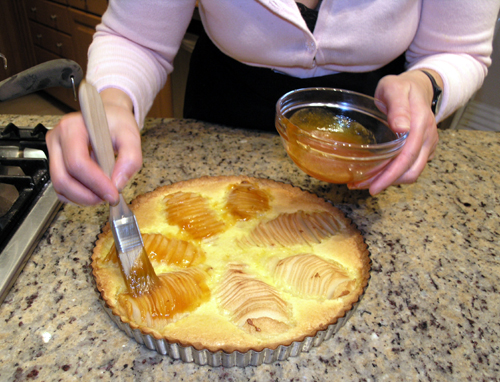
In a small pan over medium heat melt the apricot jam. Stir in the water to make the jam thinner. Strain the jam through a fine sieve to remove the fruit pieces. Brush the pear halves with a thin coat of jam. Serve lukewarm.

Friday, February 18, 2011

Beans and Pork a Perfect Combination

Today I found at WholeFoods a piece of "gambuccio" ( translated from Italian means 'small leg' ). This is the de-boned end of prosciutto and they sell it in vacuum sealed small chunks at a discounted price. You can use it as you would use "pancetta" (unsmoked Italian bacon). Gambuccio is surprisingly sweeter, leaner and less salty than other cured pork. I used it to flavor a dish of Beans Stewed with Tomato.

Here is the recipe :
Beans Stewed with Bacon and Tomato
3 tablespoons extra-virgin olive oil
1 onion, chopped
1 lb (400 gr) gambuccio, fat trimmed (substitute for Italian "pancetta" or unsmoked bacon)
2 lb (800 gr) canned pinto beans, (best would be dry Borlotti beans soaked overnight)
1 lb (400 gr) canned diced tomato
salt and pepper (or red chili pepper flakes)

Place extra virgin olive oil in a saucepan, add onion and gambuccio. 

Saute' until onion is translucent and the pork is browned.

Add beans.

Stir to combine.

Add tomato.

Cook covered for about 20 minutes, until the beans are tender but still firm and not overcooked. Add 1/2 cup water during cooking if needed.


Friday, February 11, 2011

Alfredo, and who on earth was he?

If you ask for Pasta Alfredo in a restaurant in Italy all you get from your waiter is a stare. Why is one of the most famous “Italian sauces” for pasta unknown in its country of origin? The answer is simple: because in Italy Pasta Alfredo doesn’t exist.
 
Yes, Italians make a dish of pasta, fettuccine dressed with nothing else than good aged parmigiano cheese and a lot of butter, but is such a simple preparation that Italians don’t even consider it as a “recipe”.

Waverly Root in his famous book “The Food of Italy” (New York, 1971) wrote: “FETTUCCINE AL BURRO is associated in every tourist’s mind with Rome, possibly because the original Alfredo succeeded in making its serving a spectacle reminiscent of grand opera. It is the same ribbon shaped egg pasta tat is called tagliatelle in Bologna; but the al burro preparation is very Roman indeed in its rich simplicity. Nothing is added to the pasta except grated cheese and butter - lots of butter. The recipe calls for doppio burro, double butter, which gives it a golden color.”

Who was Alfredo then? Alfredo di Lelio, this was his full name, was an inspired cook who proposed this new exciting dish in the restaurant he opened in Rome in 1914. It was a high gourmet preparation in the Roman tradition of simplicity. Apparently he created his Fettuccine all’Alfredo when his wife lost her appetite during her pregnancy. To bring back her appetite he prepared for her a nutritious dish of egg fettuccine with parmigiano cheese and butter. That probably gave him the idea for his “triple butter” fettuccine.

He was an extravagant character who used to personally serve his paper-thin fettuccine with golden forks, apparently donated to him by Mary Pickford and Douglas Fairbanks, the famous silent movie stars. In the fifties and sixties, Hollywood discovered Rome. Paparazzi photographers took photos of actors such as Tyrone Power, Ava Gardner, Richard Burton, Liz Taylor, or Sophia Loren in front of a plate of Fettuccine all’Alfredo, making his restaurant famous all around the world. The restaurant is now run buy his grandson, and the golden forks are still used to serve this dish for special occasions.

Samuel Chamberlain, journalist and food writer, met Alfredo in the late 50s and wrote in his book “Italian Bouquet – An Epicurean Tour of Italy” (New York, 1958): “Finally there is the great Alfredo, showman par excellence, who draws an endless file of amazed and hungry tourists to watch his calisthenics over a dish of hot noodles. The King of Noodles has come out of retirement, and now wields his golden fork and spoon at ALFREDO ALL’AUGUSTEO, at number 31 on the Piazza Augusto Imperatore. His Maestosissime Fettuccine all’Alfredo are most majestic, without a doubt. […] You have to visit this place at least once, we suppose, just to say you have seen this elderly, melodramatic good-hearted clown in action.”


Pasta all'Alfredo 
see also http://www.annamariavolpi.com/pasta_alfredo_recipe.html

Prepare fresh fettuccine using my recipe on this page http://www.annamariavolpi.com/page31.html or substitute with one box Italian dry egg noodles (about 1/2 lb, or 225 gr).


1/2 lb (225 gr) butter, at room temperature
salt 
1/2 lb (225 gr) parmigiano reggiano cheese, freshly grated

Place half of the butter in a serving bowl, large enough to contain the pasta. Keep the bowl warm. 

Cook the fettuccine in abundant salted water. When the pasta is perfectly al dente, (firm but not too soft or overcooked), reserve a few tablespoons  of the cooking water.

Drain without shaking the colander too much, so that the pasta doesn’t become too dry. Drop the hot pasta in the bowl over the butter.

Add the rest of the butter and toss quickly to melt it.
Add the parmigiano reggiano cheese, and a small quantity of the reserved cooking water if the pasta appears too dry. Toss vigorously, and serve immediately, accompanied by a small bowl with more grated parmigiano reggiano cheese, for the guests to add if they like.


Friday, February 04, 2011

Raisin Cookies


Soft, delicate and tasty, these cookies are simple to make and easy to store. They can be enjoyed at tea time, for a light snack, as well as a light breakfast


see also http://www.annamariavolpi.com/raisin_cookies.html
3 oz (100 gr) dark raisin 
1 lemon
2 cups (300 gr) flour + some for the workboard
1/2 cup (100 gr) sugar 
6 oz (150 gr) butter, lukewarm 
1 eggpinch of salt
for the egg wash 
1 egg 
powdered sugar


* Soak the raisin in a small bowl filled with warm water, until soft. Squeeze to remove excess water.  
* Grate the lemon rind
* Juice half of the lemon.
* Spread 2 cookie sheets with butter, and sprinkle with a small amount of flour.
* Preheat oven 350 F (180 C).

Pour the flour on a work surface, in a mound shape with a hole in the center. Add in the well the sugar, butter, egg, pinch of salt, lemon juice, and grated lemon rind. Using a fork, mix the ingredients together with the flour.

Use a scraper to keep the compound together. Work rapidly with your hands to form dough. Avoid warming the dough too much. Sprinkle the work surface with some flour to prevent the dough from sticking to the table.

When the dough is smooth and consistent, flatten it with a rolling pin.

Spread the raisin on the dough. Fold the dough and knead it again until the raisin is evenly distributed, adding some flour if necessary.


Flour the work surface. Flatten the dough with a rolling pin to a thickness of about 1/4” (5 mm). Cut the dough in round shapes to obtain the cookies.Work the cuttings of the dough again, flatten and cut more cookies. Repeat this step until all the dough is used.

Beat the egg in a small bowl, and brush the surface of the cookies.

Bake for about 20 minutes, or until golden. Sprinkle with powdered sugar.

Friday, January 28, 2011

Saltimbocca "alla Romana"

Saltimbocca are veal scaloppini prepared very simply by assembling together slices of tender veal, prosciutto, and fresh sage leaves

< The name means ‘jump into the mouth’ the idea being that saltimbocca is so delicious that [it] prompts you almost by its own volition to pop a piece of it in without hesitating for an instant > as Waverly Root, famous journalist and food writer describes them.

Scaloppini are very popular in Italy, but in the United States it is quite difficult to find a butcher who knows how to properly cut them. Scaloppini are thin slices of veal cut from the top round, and the slices should be cut across the vein of the muscles so that the fibers of the meat are short and the meat is tender. If they are cut along the vein, as they usually are in the US, the meat curls and toughens while cooking. To help prevent the meat from toughening, make the slices very thin and thump them with a meat.

While there are many variations on this dish with the addition of cheese or Marsala wine, we opted for the simplest recipe, as it is cooked in Roman kitchens. (Please keep your cooking simple .... )


Saltimbocca alla Romana
Veal Scaloppini with Prosciutto and Sage

2 oz (60 gr) flour
salt
4 veal scaloppini  slices,  about 1 lb (approximately 450 gr) 
4 prosciutto slices,  approximately 
3 oz (80 gr) 
4 leaves of fresh sage 
2 – 3 tablespoons extra-virgin olive oil 
3 tablespoons (40 gr) butter
pepper
1/2 cup (120 cc) dry white wine

Put the flour on a large plate and add a pinch of salt. Dredge the veal slices in the flour, so that they are all well covered on both sides. Shake away the excess flour.
Place on each slice of meat, a slice of prosciutto ....

... and a leaf of fresh sage.

Secure the three together with a toothpick.
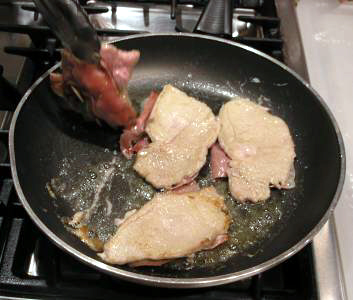
In a large frying pan, put the oil and the butter, and turn the heat to medium. When the butter begins foaming, place the meat in the pan. Season with salt and pepper. Be careful about salt as prosciutto is generally quite salty already.

Fry gently on both sides until light brown.

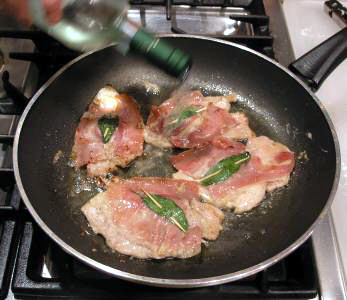
Add the wine, turn the heat to medium high, and let the wine evaporate. Place on individual plates, covering the slices with the sauce and serve warm.


Friday, January 21, 2011

Scallops: delicious and easy to prepare

You want to prepare something special but no time to cook? Scallops are the perfect food for the occasion.

Scallops are a marine bivalve mollusk (similar to mussels and oysters) found in the oceans all over the world. The name scallop comes from the French ‘escalope’, which means shell. The shells are sometimes bright colored and have the characteristic fluted fan shape.

They do not anchor to rocks but they lay on the bottom of ocean floor where they move opening and closing the shell. To do this they have a very large muscle, much larger than those of other mollusks.  The internal body has mainly two parts: a bright orange ‘tongue’ and a large white muscle.

While the whole organism is edible (in Europe and in the East they eat it entirely like oysters) in the US only the white muscle is eaten. It looks like a white solid cylinder of flesh. The flavor is very delicate and is generally prepared with mild, butter based sauces to avoid covering its taste.
 
 Here is a simple and delicious recipe that can be arranged in few minutes.


Scallops with Basil 
see also http://www.annamariavolpi.com/scallops.html
1 lb (400 gr) shelled scallops
salt and pepper
flour for dusting
2-3 tablespoons extra-virgin olive oil
1 garlic clove, mashed
1 tablespoon butter
2-3 tablespoons lemon juice
2 tablespoons chopped fresh basil


Season the scallops with salt and pepper, and dust lightly with flour, shacking off the excess.

Heat the oil in a frying pan, and add the scallops. Reduce heat to medium high and sauté for about 2 minutes on all sides.

Add garlic and cook for 2 more minutes until golden and just firm....

... sprinkle with lemon juice, add butter and a few tablespoons of water if the pan is too dry.

Add basil, toss to blend, and serve warm.